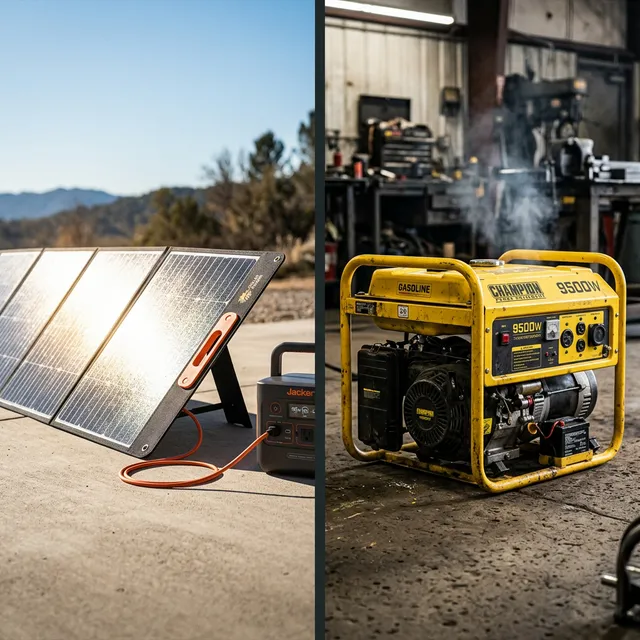
Gas generators offer cheap, massive power but require fuel stockpiles and maintenance. Solar power stations are silent, safe indoors, and run on free energy, but have limited capacity. The best setup for PR is often a hybrid: a gas generator for heavy loads and a battery station for quiet nighttime use.
If you are deciding between a solar vs gas generator for your home in Puerto Rico, understanding the total cost of ownership and fuel logistics is essential. When outfitting your home for the Caribbean hurricane season, the primary debate always distills down to the fuel source: do you rely on traditional combustible fuels, or do you harness the sun? When pitting a solar power station vs gas generator, both possess distinct advantages. To separate marketing hype from physical reality for a generator for home in Puerto Rico, let’s break down the head-to-head data.
The Vulnerability of Gasoline
The most common mistake is comparing the retail price to the retail price. A gas generator is essentially the downpayment on a gasoline subscription, whereas a solar station is a fully pre-paid energy reserve.
During a Category 4 hurricane aftermath, local infrastructure collapses. Gas stations lose grid power, their underground pumps fail, and lines stretch for miles. Gasoline becomes the most valuable currency on the island, creating immense stress. To mitigate fuel supply bottlenecks, many homeowners choose a dual-fuel generator that can run on propane tanks.

5-Year Outage Total Cost of Ownership (30 Days of Outages/Year)
| Scenario Metric | 4500W Inverter Gas Generator | 2000Wh Solar Power Station + 400W Panels |
|---|---|---|
| Initial Cost | ~$950 | ~$1,800 |
| Daily Fuel (12hr) | $18.00 (Gas at $3.25/gal) | $0.00 (Solar Recharge) |
| Annual Maintenance | ~$600 (30 days fuel + oil) | $0.00 |
| 5-Year Extra Cost | $3,000+ | $0.00 |
| Total Investment | $3,950+ | $1,800 Fixed |
Note: Daily gasoline estimates are based on volatile Puerto Rico gas prices which tend to spike during regional crises.
“Gas Generators win the instant affordability battle. Solar Generators rapidly win the long-term TCO war by entirely eliminating the volatile cost of gasoline.”
Maintenance & Critical Reliability
Solar Power Stations
Solid-state technology is virtually maintenance-free. Modern LiFePO4 battery cycle life data confirms that Lithium Iron Phosphate chemistry guarantees up to 3,000 to 3,500 charge cycles before degrading to 80% capacity—equating to over 10 years of daily use. Push a button, get instant power. For a comparison of leading brands, read our EcoFlow vs ALLPOWERS Puerto Rico review.Gas Generators
Combustion engines require meticulous maintenance. The leading cause of generator failure during a PR blackout is gasoline degradation in storage. Left in the carburetor for 6 months, stale gas transforms into a thick varnish that clogs the fuel jets.Solar Irradiance vs. Grid Economics in Puerto Rico
According to the US Energy Information Administration (EIA), Puerto Rico electricity costs vs. national average are roughly double, hovering between 24¢ and 28¢ per kWh compared to the US mainland average of 16¢. This makes grid electricity an expensive way to recharge batteries, adding weight to the case for solar charging.
Furthermore, Puerto Rico has an exceptional solar resource. According to Puerto Rico solar irradiance mapping, the island receives an average of 5.5 peak sun hours per day. A typical 400W solar panel array can easily harvest 2.2 kWh of clean energy daily, providing complete independence from both the local utility grid (LUMA) and gas stations.
The Ultimate Verdict: The Hybrid Approach
For absolute resilience in Puerto Rico, the data dictates a Hybrid Approach. Relying on a single point of failure is bad engineering. Utilize a completely silent solar power station overnight inside your bedroom—which is especially crucial if you live in a restricted multi-family building (see our apartment power station guide)—and fire up an inverter generator for 4 hours during the afternoon to run heavy tasks: cooling the house down with the window AC and instantly quick-charging the solar base station via a 120V wall outlet.
Build Your Resilient Backup Setup
Relying on a single power source is risky. Combine clean solar backup with reliable inverter generators.