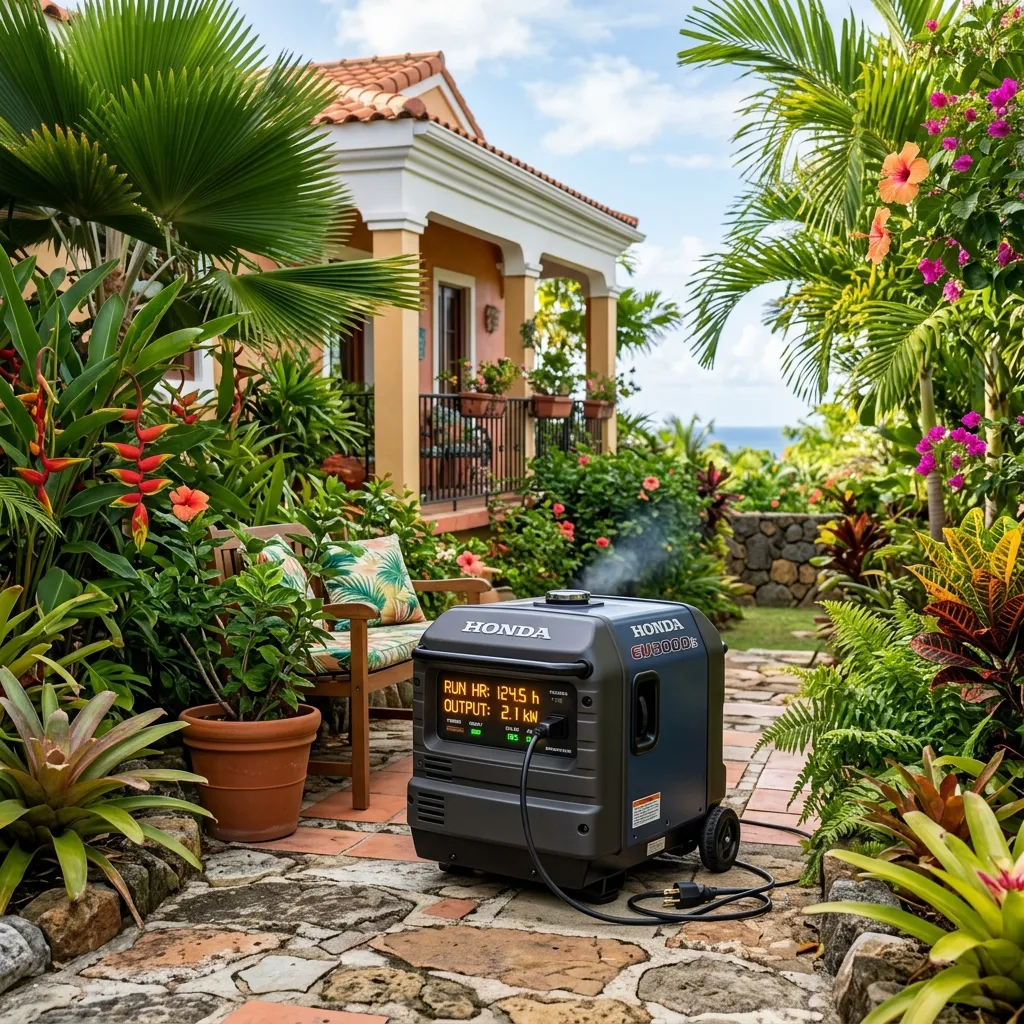
To plan your fuel storage during a long-term LUMA blackout in Puerto Rico, you need to understand the math of fuel consumption. While conventional open-frame generators consume a high baseline level of fuel regardless of load, inverter models dynamically adjust engine throttle to save up to 50% on fuel. This guide details typical runtimes, explains how to calculate consumption based on load factors, and provides our interactive calculator to estimate your daily fuel costs.
If you are dealing with rolling blackouts, grid instability, or preparing for storm outages, the most critical question is: how long does a generator run on a tank of gas?
When a major hurricane hits the island, gasoline becomes a precious resource. Long lines at gas stations and fuel supply caps mean you cannot afford to waste fuel. Understanding your generator’s fuel consumption rate, managing its electrical load, and knowing how to extend its runtime are essential skills for surviving grid outages.
This guide breaks down typical runtimes, explains how to calculate your generator’s fuel consumption, and compares gas runtime with the silent operation of solar battery stations.
What Determines How Long a Generator Runs?
Many manufacturers advertise runtimes like “Up to 12 hours!” on retail packaging. However, these figures are tested under ideal laboratory conditions (typically at a very low 25% or 50% load) and do not reflect real-world conditions during a hot summer day in Puerto Rico when you are running multiple appliances.
Four primary factors determine your actual generator runtime:
- Engine Load (Wattage Demand): The amount of electricity you draw directly affects fuel consumption. Running a refrigerator and a few fans (light load) uses far less gas than running a water heater and a window air conditioner (heavy load).
- Fuel Tank Capacity: Runtimes are directly limited by the physical size of the gasoline tank. A small 1.1-gallon tank will need frequent refuels compared to a larger 5-gallon or 8-gallon tank.
- Engine and Alternator Efficiency: Modern inverter generators throttle engine speed to match the active load, whereas conventional generators run at a fixed speed (typically 3,600 RPM) regardless of whether you are charging a phone or running a microwave.
- Fuel Type (Gasoline vs. Propane vs. Natural Gas): If you use a dual-fuel generator, you will get slightly different runtimes based on your fuel source. Gasoline has a higher energy density than propane, meaning it runs longer per gallon. According to the US Department of Energy, propane has about 27% less energy content by volume than gasoline, which translates to a 10% to 15% reduction in runtime on an equivalent volume, though it burns much cleaner and does not clog the carburetor.
Runtime by Generator Size: Quick Reference Table (2,000W–10,000W)
The table below outlines typical fuel consumption rates and runtimes for standard generator sizes at a 50% electrical load. Runtimes are based on average tank sizes and compare inverter models with conventional ones.
| Generator Capacity | Tech Type | Tank Size (Gals) | Runtime at 50% Load | Fuel Consumption Rate |
|---|---|---|---|---|
| 2,000W–2,500W | Inverter | 1.1 Gal | 8 – 11 hours | ~0.10 Gal/hr |
| 3,500W–4,500W | Inverter | 2.3 Gals | 10 – 14 hours | ~0.18 Gal/hr |
| 3,500W–4,500W | Conventional | 3.4 Gals | 7 – 9 hours | ~0.42 Gal/hr |
| 5,500W–6,500W | Inverter | 3.6 Gals | 9 – 12 hours | ~0.33 Gal/hr |
| 5,500W–6,500W | Conventional | 5.0 Gals | 8 – 10 hours | ~0.55 Gal/hr |
| 7,500W–9,000W | Conventional | 6.5 Gals | 7 – 9 hours | ~0.80 Gal/hr |
| 10,000W–12,000W | Conventional | 8.2 Gals | 6 – 8 hours | ~1.10 Gal/hr |
Notice that a 3,500W conventional generator consumes more fuel per hour than a 5,500W inverter generator, showing the massive efficiency advantage of inverter technology.
Inverter vs Conventional: Which Uses Less Gas During a LUMA Outage?
In Puerto Rico, where residential electricity costs are double the national average and gas prices fluctuate heavily, fuel efficiency translates directly to financial savings.
How Inverter Technology Saves Fuel:
Conventional generators use a mechanical governor to keep the engine spinning at a constant 3,600 RPM. This speed is required to produce a standard 60Hz alternating current. If the engine slows down, the voltage and frequency drop, which can ruin sensitive appliances. Thus, a conventional generator burns gas at a high rate even if you are drawing zero power.
In contrast, an inverter generator converts the raw AC power into DC power, and then digitally inverts it back into a perfect 60Hz pure sine wave AC current. Because the frequency is controlled digitally, the engine is free to slow down (throttle down) to match your load. When running only light devices (lights, fan, router), the engine runs at a whisper-quiet idle, saving up to 40% to 50% on fuel.
To compare fuel and pricing differences for inverter models, review our selection of Inverter Generators.
How to Calculate Your Generator’s Fuel Consumption (With Examples)
If you want to estimate how much fuel you will need to store for a potential hurricane or extended outage, use the formula below to calculate hourly fuel usage based on your generator’s specifications:
🧮 Fuel Consumption Formula
Example: If a generator has a 3.6-gallon tank and a runtime of 12 hours at 50% load, the hourly fuel rate is: 3.6 / 12 = 0.3 gallons per hour.
Interactive Fuel Calculator
To make planning easier, we have built an interactive generator fuel consumption calculator below. You can select a common generator preset or adjust the parameters (tank capacity, runtime at 50% load, daily run hours, load factor, and local fuel prices) to estimate your exact fuel needs and daily costs.
⚡ Interactive Generator Fuel Calculator
Estimate your fuel requirements and costs during a LUMA power outage.
📊 Estimated Fuel Requirements
Scenario: Storing Fuel for a 5-Day Outage
Suppose you own a mid-sized inverter generator (like the Champion 5,500W) and plan to run it for 10 hours a day during an outage:
- Hourly Consumption: 0.3 gallons per hour.
- Daily Consumption: 0.3 GPH x 10 hours = 3.0 gallons per day.
- 5-Day Total: 3.0 gallons x 5 days = 15.0 gallons of fuel.
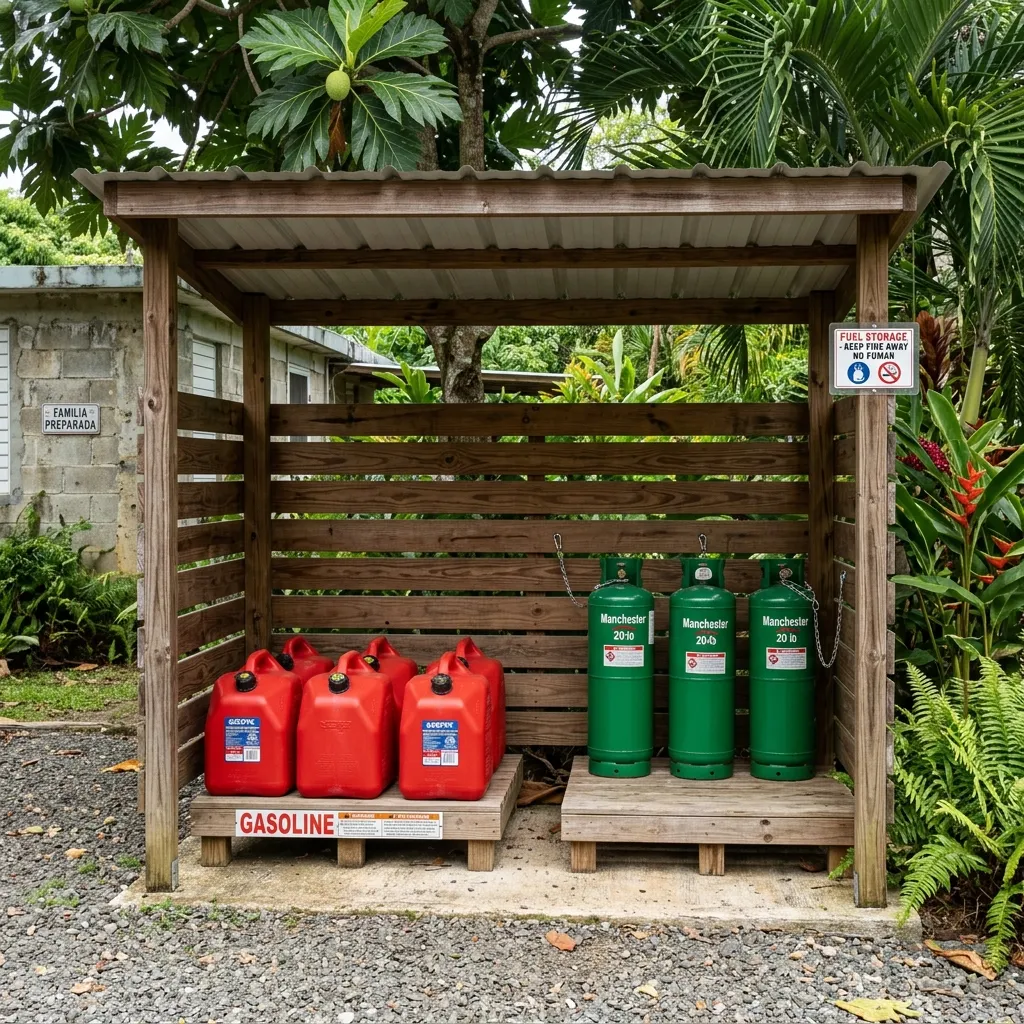
If you were running a conventional generator of the same size, your daily consumption would be closer to 5.5 gallons, requiring 27.5 gallons of storage—making fuel management much more difficult and dangerous.
How Long Do Battery Power Stations Last vs Gas Generators?
If storing and managing fuel feels too risky, portable battery power stations (solar generators) are a compelling alternative. Instead of burning gas, battery stations store electrical energy from the grid or solar panels.
Battery Runtime Examples:
A common misconception is that household appliances consume their peak wattage continuously. For example, while a full-size residential refrigerator has a high starting surge (often 1,200W–2,000W), its compressor only cycles on occasionally.
According to real-world tests and YouTube energy monitoring demonstrations under daily household usage, a modern Energy Star full-size refrigerator consumes only 1.2 kWh to 1.5 kWh (1200Wh to 1500Wh) per 24 hours. This means a premium 2,000Wh battery power station can easily run a full-size refrigerator for 24 to 30 hours on a single charge without any solar input, as its average continuous power draw is only 50W to 60W.
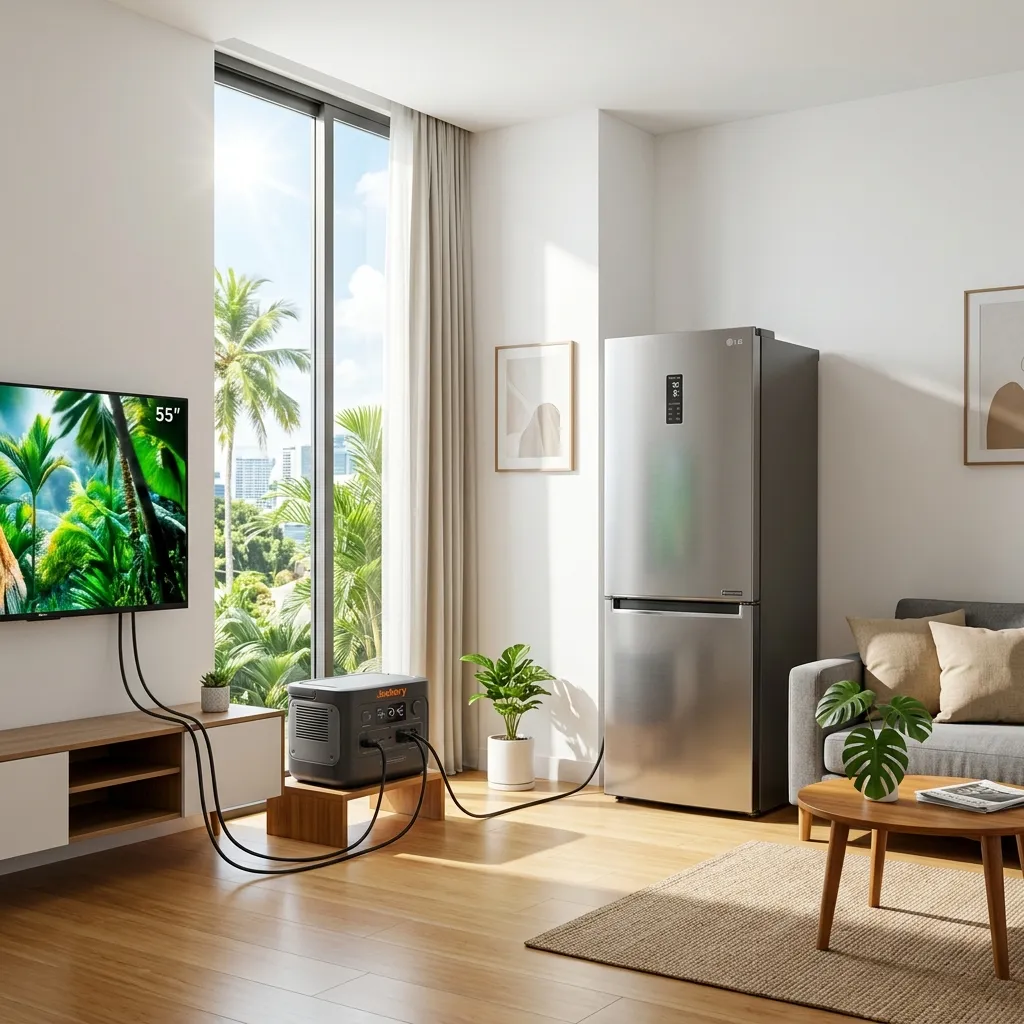
Here is how long a 2,000Wh premium battery power station will run typical household electronics during a blackout:
Instead of listing a specific battery model, we recommend exploring our complete Battery Power Stations Catalog to compare capacities and find the right fit for your home. While gas generators can run indefinitely as long as you have fuel, battery power stations are limited by their storage capacity. However, they can be recharged during the day using portable solar panels, giving you complete fuel independence.
Use Our Free Puerto Rico Generator Wattage Calculator
To accurately determine how long a generator will run or what size you need, you must first calculate your home’s total electrical wattage.
Do not rely on rough estimates. Every appliance has unique starting and running watt demands. Use our free, interactive Generator Wattage Calculator (also known as a vatiaje generador calculator) to add up your specific household devices and get an optimized, safe power recommendation.