
For most Puerto Rico homeowners in 2026, the best setup is a hybrid approach: a 3,500–4,500W inverter generator for heavy daytime loads (AC, fridge, power tools) paired with a high-capacity LiFePO4 battery station for silent nighttime use. Apartment residents should invest in a 2,000Wh+ battery power station with folding solar panels. Budget at least $1,500–$3,000 for reliable hurricane-grade backup power — it pays for itself after one major outage.
If you are searching for the best generator for Puerto Rico in 2026, this comprehensive buying guide compares every category of backup power — inverter generators, battery power stations, and dual-fuel models — with real cost data, runtime calculations, and picks optimized for the island’s unique grid vulnerabilities. For detailed resources, read our Generators for Puerto Rico Buyer’s Guide and explore our Inverter Generators Guide. Puerto Rico’s power grid remains one of the most fragile in the United States. According to the U.S. Energy Information Administration (EIA), Puerto Rico customers experience an average of over 80 hours of power interruptions per year — roughly 12 times the U.S. mainland average of 7 hours. LUMA Energy, the private operator managing the island’s transmission and distribution network since 2021, inherited decades of deferred maintenance, aging infrastructure, and hurricane damage that federal audits have documented extensively.
The question is no longer if you need backup power — it is which type of backup power is the smartest investment for your home, your budget, and your family’s safety. Whether you are preparing for the 2026 hurricane season, protecting against LUMA’s regular rolling blackouts, or seeking energy independence after the cancellation of federal solar funding, this guide gives you the evidence-based framework to make the right decision.
The Three Categories of Backup Power
Before comparing specific models, you need to understand the three fundamentally different technologies available. Each has distinct strengths that matter specifically in Puerto Rico’s tropical climate and logistical reality. If you have already decided on a type and need to calculate your wattage requirements, use our interactive generator sizing calculator.
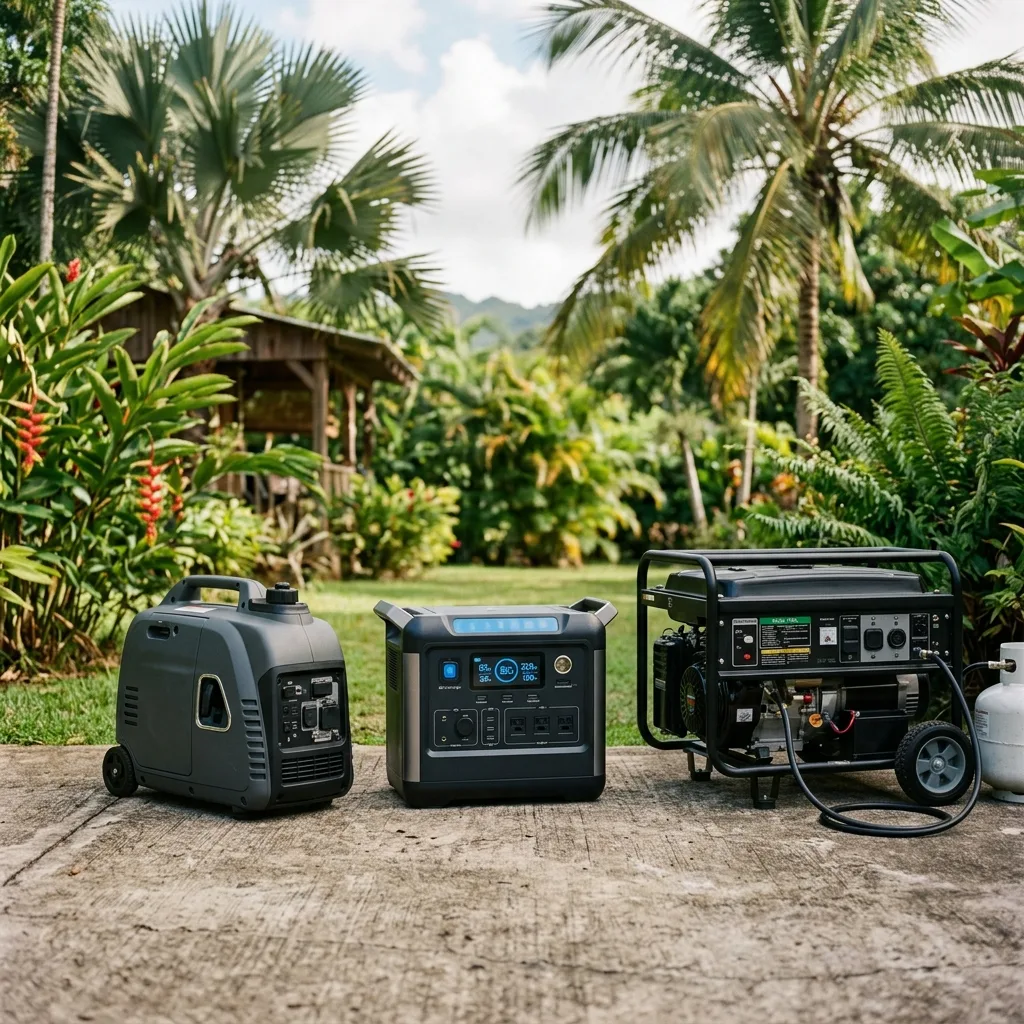
Inverter Generators (Gas/Propane)
Produce clean, pure sine wave power (<3% THD) that is safe for sensitive electronics. They throttle engine speed based on load, saving 20–40% on fuel compared to conventional generators. Best for: homeowners who need 3,000W+ continuous power for refrigerators, AC units, and power tools. Read our complete guide: Inverter vs Conventional Generator.
Battery Power Stations (Solar/LiFePO4)
Completely silent, zero-emission units that can operate safely indoors. Modern LiFePO4 stations offer 3,500+ charge cycles (10+ years) and recharge via solar panels, AC wall outlets, or car chargers. Best for: apartment residents, nighttime use, medical devices (CPAP), and internet continuity. Read our complete guide: Best Power Station for Blackout.
Dual-Fuel & Tri-Fuel Generators
Run on both gasoline and propane (LP), giving you fuel flexibility when gas stations run dry after a hurricane. Propane has a shelf life of 25+ years vs. 90 days for gasoline in PR heat. Best for: homeowners who want maximum fuel resilience and longer runtime. Read our complete guide: Dual-Fuel vs Tri-Fuel.
Our 2026 Top Picks for Puerto Rico
After testing, researching, and shipping dozens of generator systems to homes across Puerto Rico — from San Juan condos to Utuado mountain homes — these are the categories and specifications we recommend for 2026. Prices reflect our competitive mainland-sourced pricing; for details on how we ship to Puerto Rico and handle IVU tax, see our shipping guide and SURI IVU process.
| Category | Recommended Specs | Type | Best For | Est. Price |
|---|---|---|---|---|
| 🏆 Best Overall | 4,500W–5,500W Inverter, Dual-Fuel (Gas + Propane) | Gas | Homes with yard space | $1,500–$1,800 |
| ⚡ Best Battery Station | 2,016Wh–3,600Wh LiFePO4, 3,000W–4,000W Output | Battery | Hybrid setups, home backup | $1,100–$2,100 |
| 💰 Best Budget | 3,500W–4,500W Inverter, Gas or Dual-Fuel | Gas | Budget-conscious homeowners | $1,000–$1,200 |
| 🏠 Best Whole-House | 7,500W–11,000W Starting (6.5kW–9kW+ Running), Tri-Fuel | Gas | Large homes, central AC | $2,300–$3,500 |
Why We Recommend Inverter Generators Over Conventional
Many big-box stores sell cheap conventional generators for $300–$500. These are a trap for Puerto Rico homeowners. Conventional generators produce “dirty power” with 15–25% Total Harmonic Distortion (THD), which — according to IEEE power quality standards — can damage the sensitive microprocessors inside modern smart refrigerators, CPAP machines, and flat-screen TVs over a multi-week outage. The inverter generator costs more upfront but protects thousands of dollars in electronics. Read the full breakdown: Inverter vs Conventional Generator in Puerto Rico.
“The cheapest generator is the one that actually runs when you need it. In Puerto Rico, reliability isn’t a feature — it is the entire product.”
5-Year Total Cost of Ownership
The sticker price is only the beginning. When you factor in fuel, maintenance, and the cost of outage events, the real economics of each generator type become clear. The table below assumes 30 days of outage per year (Puerto Rico’s documented average for homes affected by major grid events) and 8 hours of daily generator run time during outages.
| Cost Factor | 4,500W Inverter (Gas) | 4,500W Dual-Fuel (Propane Mode) | 2,016Wh Battery Station + Solar Panels |
|---|---|---|---|
| Initial Equipment Cost | ~$1,500 | ~$1,750 | ~$1,720 (R2500 + 400W panel) |
| Annual Fuel (30 days × 8 hrs) | $540 (gas @ $3.25/gal) | $360 (propane @ $3.50/gal) | $0.00 (solar recharge) |
| Annual Maintenance | $75 (oil, filter, stabilizer) | $75 (oil, filter) | $0.00 |
| 5-Year Fuel + Maintenance | $3,075 | $2,175 | $0.00 |
| 5-Year Total Investment | $4,575 | $3,925 | $1,720 |
Gasoline prices based on volatile Puerto Rico AAA gas price data, which routinely spike 30–50% during regional crises when supply chains collapse. Propane prices are significantly more stable due to long shelf life and pre-season stockpiling availability.
💡 The Break-Even Point
An investment of ~$1,720 in a battery station with 400W solar panels becomes cheaper than a $1,500 gas inverter generator by Year 2, because you never spend another dollar on fuel or maintenance. Every year after that is pure savings.
How to Choose: The Puerto Rico Decision Framework
Your ideal generator depends on exactly three variables: where you live, what you need to power, and your budget. Use this decision framework to narrow your search.
Inverter Generator
- Recommended Product: Champion 5,500W Dual-Fuel Inverter
- Wattage: 4,250 running / 5,500 starting watts
- Price: $1,898.12 (direct shipping included)
- Best For: Powering fridge, electronics, and a window AC unit simultaneously.
Whole-Home Generator
- Recommended Product: Champion 8,500W Tri-Fuel Inverter or Champion 11,000W Tri-Fuel
- Wattage: 6,500 to 9,000 running watts
- Price: $2,596.49 to $3,098.23
- Best For: Large homes running multiple mini-split ACs, water heaters, and pumps.
The Hybrid Setup
- Recommended Products: Champion 5,500W Dual-Fuel + ALLPOWERS R2500
- Components: 4.2kW Inverter + 2,016Wh LiFePO4 battery station + 400W Solar Panel
- Combined Price: ~$3,470 total
- Best For: 24/7 resilience. Run gas during the day to power AC and charge battery; run battery silently at night.
Apartment / Condo
- Recommended Products: ALLPOWERS R2500 + 400W Solar Panel
- Components: 2,016Wh LFP Power Station + 400W Folding Solar Panel
- Combined Price: ~$1,720 total
- Best For: Apartment balconies where gas engines are strictly illegal. Zero emissions and silent.
Sizing Your Generator
The single biggest mistake Puerto Rico buyers make is purchasing a generator based on its marketing label rather than calculating their actual wattage needs. A “4,500W” generator does not mean you can run 4,500 watts of appliances — you must account for starting surge watts (the 3-second burst when compressor motors kick on).
⚡ The Golden Sizing Rule
Add up all your continuous running watts, then add the highest single starting surge (usually the fridge or AC compressor). That total is your minimum generator rating.
Use our free interactive Generator Wattage Calculator to instantly audit your home’s needs, or review the full math in our What Size Generator Do I Need guide.
Quick Reference: Common Puerto Rico Home Loads
| Appliance | Running Watts | Starting Surge | Priority |
|---|---|---|---|
| Full-Size Refrigerator | 150–200W | 1,200–2,200W | 🔴 Critical |
| Window AC (8,000 BTU) | 700W | 2,200W | 🟠 High |
| Inverter Mini-Split AC (9,000 BTU) | 600W | 1,200W | 🟠 High |
| Ceiling Fan | 75W | 120W | 🔴 Critical |
| Wi-Fi Router + Modem | 20W | 20W | 🔴 Critical |
| CPAP Machine | 120W | 120W | 🔴 Critical |
| Phone Charger (×4) | 40W | 40W | 🟡 Medium |
| Flat Screen TV (55”) | 150W | 150W | 🟡 Medium |
| Microwave | 1,500W | 1,800W | 🟡 Medium |
For official appliance energy use data, refer to the U.S. Department of Energy Appliance Guide and ENERGY STAR refrigerator specifications.
Puerto Rico-Specific Factors You Cannot Ignore
Buying a generator for Puerto Rico is fundamentally different from buying one for the US mainland. These island-specific variables will determine whether your investment survives its first real test.
1. Tropical Heat & Battery Degradation
Puerto Rico’s average high temperatures of 87–92°F (31–33°C) with extreme humidity accelerate chemical degradation in standard lithium-ion (NMC) batteries. This is why we exclusively recommend LiFePO4 (Lithium Iron Phosphate) chemistry for any battery power station. According to Battery University thermal analysis and NREL battery safety research, LFP cells have a thermal runaway threshold of 270°C vs. 210°C for NMC, and they deliver 3,500+ cycles compared to NMC’s 500–1,000 cycles before dropping to 80% capacity.
2. Post-Hurricane Fuel Availability
After Hurricane Maria, gas stations ran dry within 24–72 hours. Those who had pre-filled propane tanks continued running for weeks. If you buy a gas-only generator, you are betting your family’s comfort on fuel availability during the worst possible conditions. A dual-fuel generator eliminates this single point of failure. Propane has a shelf life of 25+ years; gasoline, even with stabilizer, degrades within 6 months in PR’s heat according to EPA fuel quality standards.
3. Salt Air & Corrosion
Coastal communities in Condado, Isla Verde, Ocean Park, Rincón, and throughout the island face aggressive salt air corrosion. Gas generators with exposed metal components must be stored in covered areas and maintained more aggressively. Battery power stations with sealed enclosures are inherently more resistant. For homeowners near the coast, this tilts the calculus further toward battery or hybrid setups.
4. Shipping & IVU Tax Logistics
All heavy generator equipment must be shipped to Puerto Rico via maritime freight (lithium batteries over 100Wh are prohibited on passenger aircraft by the FAA). We handle the shipping logistics, double-boxing, freight insurance, and guide every customer through the Hacienda SURI IVU process to ensure full compliance. For a step-by-step breakdown, read our Shipping Generators to Puerto Rico guide.
5. Puerto Rico Electricity Costs
According to the EIA, Puerto Rico’s electricity rates hover between 24¢ and 28¢ per kWh — roughly double the US mainland average. This makes solar-rechargeable battery stations even more economically attractive: every kilowatt-hour you generate from solar panels saves you nearly 30 cents compared to LUMA grid power.
The Hybrid Strategy: Our #1 Recommendation
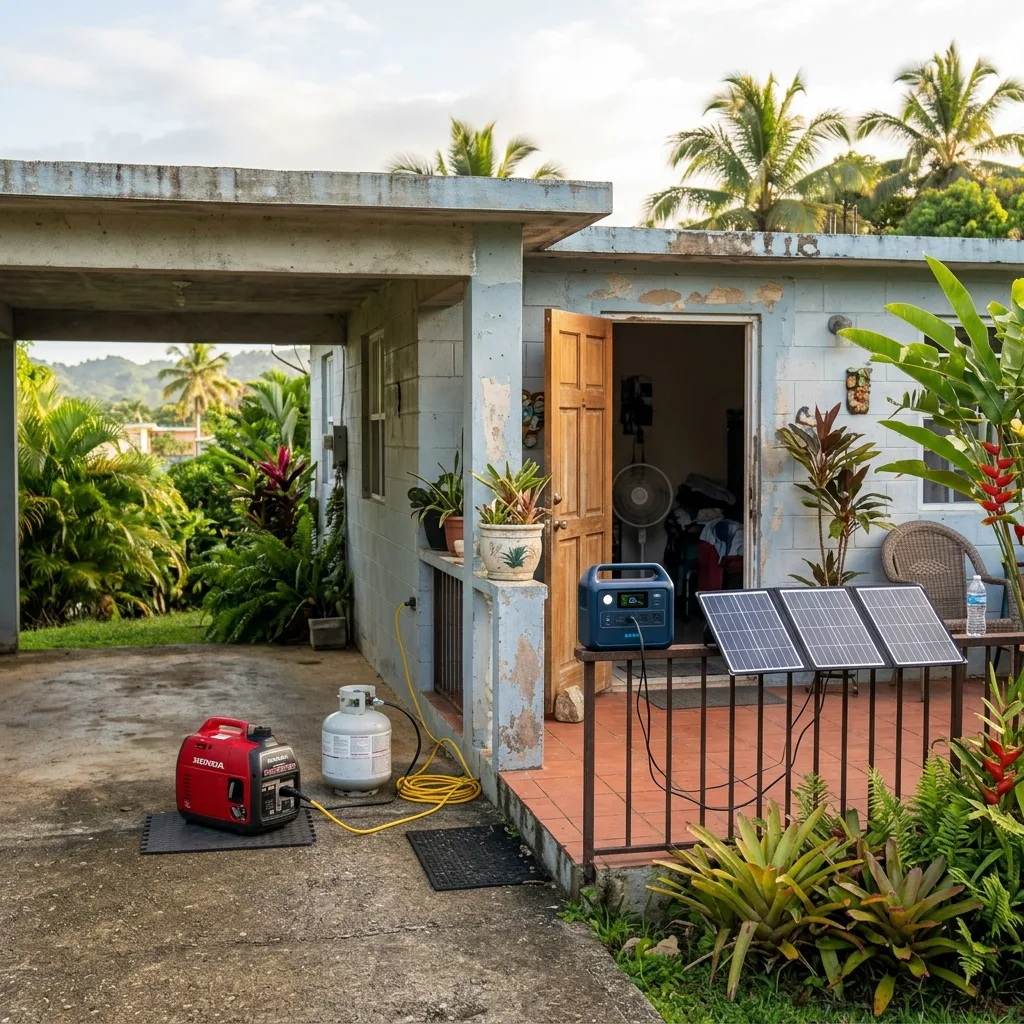
After years of shipping generators to Puerto Rico and gathering real-world feedback from our customers, we have arrived at a clear conclusion: the hybrid strategy is the best investment for most Puerto Rico homeowners.
The Recommended Build: Champion + ALLPOWERS R2500
For the ultimate home backup setup, we recommend pairing the Champion 5,500W Dual-Fuel Inverter Generator with the ALLPOWERS R2500 2,016Wh LiFePO4 Power Station and an ALLPOWERS 400W Foldable Solar Panel.
Here is how this build functions in practice:
- Daytime (4–6 hours): Run the Champion 5,500W Inverter Generator on clean-burning propane. This handles your heavy high-draw daytime loads, such as mini-split air conditioners, water pumps, microwave, and electric stove. While running, plug the ALLPOWERS R2500 into the generator’s AC outlet. Thanks to the R2500’s ultra-fast charging capabilities, it can charge from 0% to 100% in under 1.5 hours.
- Nighttime (8–10 hours): Turn off the Champion generator to save fuel and eliminate noise. Plug your refrigerator, fans, Wi-Fi router, and CPAP machine directly into the silent ALLPOWERS R2500. With 2,016Wh of capacity and a 4,000W surge output, it will power these essentials through the night without a sound.
- Solar Recharging: Connect the ALLPOWERS 400W Foldable Solar Panel during the day. Even if fuel is scarce or you choose not to run the gas engine, Puerto Rico’s average solar irradiance (~5.5 peak sun hours) allows the 400W panel to recover up to 1.6kWh of free solar energy daily.
☀️ Hybrid Runtime Formula
A Champion dual-fuel inverter running 6 hours on propane + an ALLPOWERS R2500 battery station running essentials for 10 hours + daily solar recharging provides continuous 24/7 coverage through a multi-week hurricane outage while cutting fuel consumption by 75%.
This hybrid approach eliminates the weaknesses of each individual technology: the gas generator covers the capacity gap that batteries cannot handle (AC, heavy loads), while the battery station covers the noise, emissions, and fuel dependency gaps that gas generators cannot solve. It is the engineering-correct answer.
“A generator plus a battery station is not redundancy — it is complementary engineering. Each system covers the other’s weakness. Together, they create 24/7 hurricane-grade resilience.”
Frequently Asked Questions
What is the best generator brand for Puerto Rico in 2026?
For inverter gas generators, Champion Power Equipment offers the best combination of value, reliability, and dual-fuel capability in the 3,500–9,500W range. For battery power stations, ALLPOWERS delivers the best price-to-performance ratio with LiFePO4 chemistry, high solar input, and 4,000W output. EcoFlow is a premium alternative with faster wall charging. See our detailed EcoFlow vs ALLPOWERS comparison.
Can I use a gas generator in my apartment?
No. Gas generators emit deadly carbon monoxide gas and are strictly banned on apartment balconies and corridors by local fire codes (NFPA 1). Storing highly flammable gasoline indoors is also a severe hazard. For apartments, battery power stations are the only legal and safe option. Read our dedicated guide: Best Generator for Puerto Rico Apartments.
How do I size a generator for my Puerto Rico home?
Add up the running watts of every appliance you need to power simultaneously, then add the highest starting surge (usually the fridge compressor at 2,200W). That total is your minimum generator size. For most PR homes running a fridge, fans, lights, and a window AC, a 4,500W inverter generator covers the essentials. Use our free Generator Wattage Calculator for an instant audit, or read our full sizing guide. If you want to check what models are currently available on the market, we have a list of generators for sale Puerto Rico detailing options for every budget.
Is a solar generator enough for a hurricane?
A solar-rechargeable battery power station can keep your fridge, fans, CPAP, phone chargers, and router running indefinitely — as long as the sun comes out. The risk is extended overcast periods immediately after a hurricane when solar recharging is limited. This is why the hybrid approach (gas generator + battery station) is our top recommendation. A gas generator serves as the “emergency charger” for the battery station during cloudy stretches. For solar sizing, use our solar calculator.
How do I ship a generator to Puerto Rico?
All generators over 150 lbs and battery power stations over 70 lbs must be shipped via maritime freight. We professionally double-box, insure, and ship directly to your door in Puerto Rico. Lithium battery stations require ocean freight only (no air). After receiving your shipment, you must file a SURI Levante with Hacienda to pay the IVU import tax. We guide every customer through this process. Full details: Shipping Generators to Puerto Rico.
How much does a generator cost for Puerto Rico?
Budget between $1,000 and $3,500 depending on your needs. A basic 3,500W–4,500W dual-fuel inverter starts at ~$1,000–$1,200. A high-capacity 5,500W dual-fuel inverter runs ~$1,500–$1,800. A whole-home tri-fuel generator (6.5kW to 9kW+ running) costs ~$2,300 to ~$3,500. A quality LiFePO4 battery power station like the ALLPOWERS R2500 with a 400W solar panel costs ~$1,720. The full hybrid setup ranges from $2,800–$3,500. Remember: after one major hurricane, a quality generator pays for itself by saving $1,500+ in spoiled food, hotel costs, and lost work.
⚠️ Carbon Monoxide Safety ReminderNever operate any gas or propane generator indoors, inside garages, on apartment balconies, or within 20 feet of any door, window, or ventilation opening. Carbon monoxide is an invisible, odorless killer. Always place generators in open-air locations with exhaust pointed away from all living spaces, and install battery-operated CO detectors inside your home. Review the CDC carbon monoxide prevention guide for detailed safety protocols.
Secure Your Family's Power for 2026
Shop our curated collection of inverter generators, LiFePO4 battery stations, and solar panels — all shipped direct and fully insured to Puerto Rico. We handle the logistics so you can focus on what matters.