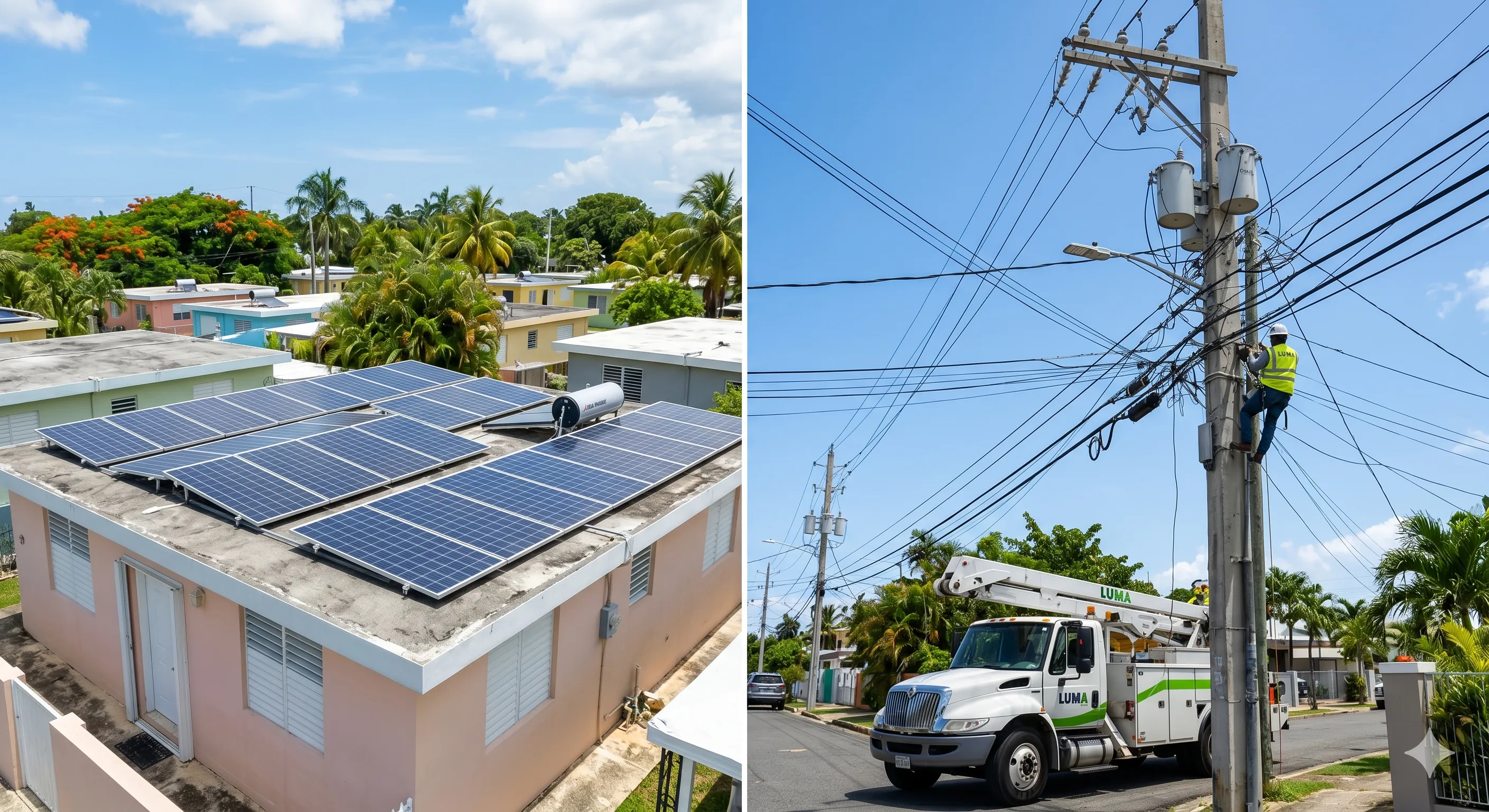
The federal $1 billion Energy Resilience Fund intended for residential solar in Puerto Rico was permanently canceled. Since institutional solutions won’t arrive before hurricane season, residents must secure their own backup power through portable power stations or inverter generators shipped directly.
In January 2026, thousands of Puerto Rican families received a message they had been dreading. After spending more than a year clearing paperwork, hosting inspections, and waiting their turn in line, they were told the federal solar program they had been counting on was over. The funding was gone.
This was not a rumor or a bureaucratic delay. The Trump administration permanently canceled the Energy Resilience Fund — a $1 billion congressional program specifically designed to give low-income Puerto Ricans and medically vulnerable residents their own solar panels and battery backup systems, independent of the LUMA grid. Only 6,000 of the 40,000 expected installations were completed before the money disappeared.
For families like María Pérez of Salinas — who survived three months without power after Hurricane Maria and was waiting on a solar-and-battery system to protect her heart condition — it was a devastating reversal. “My turn was next,” she told Grist. “It’s done in shifts, and I was next. Why did this happen?”
It’s a fair question. And the answer has real implications for every homeowner on this island heading into the 2026 hurricane season.
What the Energy Resilience Fund Was — and Why It Mattered
After Hurricane Maria destroyed the Puerto Rico grid in 2017 and left residents without power for up to a year, it became painfully clear that centralized grid infrastructure alone could not protect this island. Roughly 3,000 people died — not from the storm itself, but from the collapse of the grid and health infrastructure that followed. Diabetics lost refrigeration for insulin. Dialysis patients lost access to treatment. Ventilator-dependent residents lost power entirely.
In 2022, Congress acted. As part of a bipartisan appropriations package, lawmakers set aside $1 billion for the Energy Resilience Fund, earmarked specifically to install rooftop solar panels and battery storage systems for low-income Puerto Ricans and those with medical conditions. The goal was simple: give the island’s most vulnerable residents energy independence, so that when the next storm hit, they would not be left at the mercy of a grid that has already failed them twice.
The program worked, by every measure, for the 6,000 families who received installations before funding was pulled. Distributed solar is exactly what energy experts have recommended for Puerto Rico’s grid vulnerabilities for years — it is resilient by design, because it cannot all go down at once.
Program Completion at Cancellation
Then the administration changed, and so did the priorities.
Where Did the $1 Billion Go?
The Department of Energy did not simply return the unspent money to the Treasury. More than a third of the canceled solar funding was redirected — without competitive bidding — directly to PREPA, the Puerto Rico Electric Power Authority.
This decision raised immediate alarms among energy policy experts. PREPA is a utility with a well-documented history of corruption and mismanagement. It has been navigating bankruptcy for nearly a decade, one of the longest utility bankruptcies in U.S. history. After Hurricane Maria, Congress gave PREPA more than $17 billion to modernize the island’s grid. By 2026, the utility had completed just 16 projects and spent less than $100 million of those funds.
A former Energy Department official put it plainly to Grist: “Why would you cancel something that is working as intended and being executed, to give it to someone that has a bad history?”
The DOE designated the PREPA funds for “key emergency activities designed to address critical vulnerabilities across generation, transmission, and distribution systems” — the same grid that has been receiving federal money for modernization since 2017 with limited results. Crucially, the grant was structured as noncompetitive, meaning the DOE did not solicit bids from other organizations before making the decision.
“Why would you cancel something that is working as intended and being executed, to give it to someone that has a bad history?” — Former U.S. Department of Energy Official
The Reality of Puerto Rico’s Grid in 2026
Puerto Rico currently holds the distinction of having the highest rate of electrical outages of any U.S. territory or state. Electricity on the island costs roughly double the national average. The grid continues to rely heavily on imported fossil fuels — oil, natural gas, and coal — with generating stations concentrated on the southern coast and a network of transmission lines running through mountainous terrain to reach population centers in the north.
This infrastructure failed catastrophically under Maria in 2017. It buckled again under Hurricane Fiona in 2022. And with forecasters projecting an above-average 2026 hurricane season driven by La Niña conditions and elevated Atlantic sea surface temperatures — conditions our 2026 Hurricane Season Almanac covers in detail — there is no credible reason to believe the outcome will be different the next time a major storm hits.
Puerto Rico vs. The National Average: Annual Hours Without Power
Source: EIA, DOE. PR figure reflects cumulative outage hours measured after Hurricane Maria and Hurricane Fiona.
The window for institutional solutions has effectively closed for this year’s hurricane season. PREPA will not rebuild the grid before June. Federal policy has shifted away from distributed solar for individual families. That means the responsibility for protecting your home and your family falls on you — and the good news is, it always was within reach.
What Your Actual Options Are Right Now
The federal program that was canceled would have installed rooftop solar and battery storage through a contractor, using subsidized funding. That specific pathway is no longer available. But the underlying technology — portable battery power stations and solar generators — is available to any Puerto Rican homeowner today, at a range of price points, shipped directly and insured to your door.
Here is how to think about what you actually need:
Option 1: The Silent Indoor Solution (Apartments & Condos)
If you live in a condominium or apartment where gas generators are prohibited — which they are on most balconies under fire code — a battery power station paired with foldable solar panels is your only viable option, and it is a legitimate one. A quality battery power station in the 1,000–2,000Wh range can run a full-size refrigerator for 8–12 hours, keep a CPAP machine running overnight, and charge phones and tablets for several days. Pair it with 200 watts of foldable solar panels and you can recharge the unit during daylight hours indefinitely. Silent. Zero emissions. No fuel required. Our full guide to condo and apartment power solutions walks through exactly how to set this up.
Option 2: The Suburban Gas Generator
For a standalone home, a 4,000–6,500 watt inverter gas generator remains the most cost-effective way to power essential home systems through a multi-day outage. Modern inverter generators run significantly quieter than conventional generators (critical for neighbors and your own sanity at 2am), produce cleaner power that is safe for sensitive electronics, and — when dual-fuel models are chosen — can run on propane as a backup when gas stations run dry after a storm. Not sure what size you need? Our Generator Sizing Calculator will give you an exact wattage figure based on your specific appliances.
Option 3: The Hybrid Approach
The most resilient setup for a Puerto Rican home combines both: a gas generator for heavy loads (air conditioning, refrigerator, water pump) and a battery power station that charges from the generator and provides clean, silent power overnight when you do not want to run the engine. This mirrors exactly what the canceled federal program would have provided — just without the rooftop solar component. For most families, the solar addition can come later.
| Option 1: Battery + Solar | Option 2: Gas Generator | Option 3: Hybrid | |
|---|---|---|---|
| Best For | Apartments / Condos | Suburban homes | Maximum resilience |
| Noise Level | Silent (≈30 dB) | 65–72 dB | Mixed |
| Fuel Required | None (solar) | Gasoline / Propane | Both |
| Indoor Safe? | YES | NO | Mixed |
| Price Range | $600 – $2,500 | $500 – $1,800 | $1,200 – $4,000 |
| Runtime | Unlimited with solar | Limited by fuel | Unlimited |
The Broader Lesson: Grid Independence Is Personal
The cancellation of the Energy Resilience Fund is frustrating, and it is legitimate to be angry about it. Families who cleared every hurdle and waited patiently for their turn in a federally managed program were let down by a policy reversal that had nothing to do with their effort or eligibility.
But the core lesson of Maria, Fiona, and every LUMA outage between them is unchanged: the Puerto Rico grid cannot be your primary backup plan. It has failed too many times, with too many consequences, for that to be a reasonable strategy going into another above-average hurricane season.
The families in Puerto Rico who came through Maria with the least hardship were not the ones who were waiting for the grid to come back. They were the ones who had already made their own arrangements. A generator in the garage. A battery station on the shelf. A few solar panels on the patio. The price of that independence has never been lower than it is today, and it ships directly to your door.
Frequently Asked Questions
Can I still get any government help for solar or backup power in Puerto Rico?
The federal Energy Resilience Fund program for individual households has been canceled. However, Puerto Rico’s local incentive programs may still offer some assistance — check with the Puerto Rico Energy Bureau (PREB) and local solar installers for current availability. Some utility bill credit programs may also apply for grid-tied rooftop solar installations through private companies.
Is there still time to prepare before the 2026 hurricane season?
Yes — but the window is closing. Hurricane season officially begins June 1, with the statistical peak danger window for Puerto Rico running from mid-August through late October. The critical logistics deadline is approximately 96 hours before a named storm enters the cone of uncertainty, when maritime shipping suspensions and local retail sellouts make reliable equipment nearly impossible to source. Ordering now, in April, gives you the widest selection and the lowest prices.
Are portable battery power stations actually useful during a real hurricane outage?
Yes, for specific loads. A 1,500–2,000Wh battery station will not run central air conditioning, but it will reliably power a full-size refrigerator, a CPAP machine, phone chargers, fans, lighting, and a small window AC unit (with a higher-capacity model). For the loads that matter most during a multi-day outage — food, medical devices, and communication — they are highly effective.
What is the difference between a solar generator and a battery power station?
The terms are often used interchangeably in marketing, but there is a distinction worth knowing. A battery power station is the battery unit itself — it stores electricity and powers your devices. A solar generator typically refers to the combination of a battery power station and solar panels. The solar panels charge the battery from sunlight, allowing indefinite operation without grid power or fuel. Our full comparison guide explains the options in detail.
Why does PR Electric Direct ship from the mainland instead of stocking locally?
Sourcing from the mainland allows us to offer the full catalog of premium brands — Champion, Honda, EcoFlow, Jackery, Bluetti, and more — at prices that local Puerto Rico retailers cannot match due to limited inventory and import margins. Every shipment is double-boxed, professionally inspected, and fully insured for the journey to the island. We treat every order as if we were shipping it to our own family.
Don't Wait for Another Storm — Equip Your Home Today
Browse our full catalog of inverter generators, solar power stations, and foldable solar panels — all shipped directly to Puerto Rico, double-boxed and fully insured.
The PR Electric Direct team researches and curates power solutions specifically for Puerto Rico’s energy environment. We monitor grid reliability, hurricane forecasts, and energy policy developments year-round. Questions? Contact us directly.