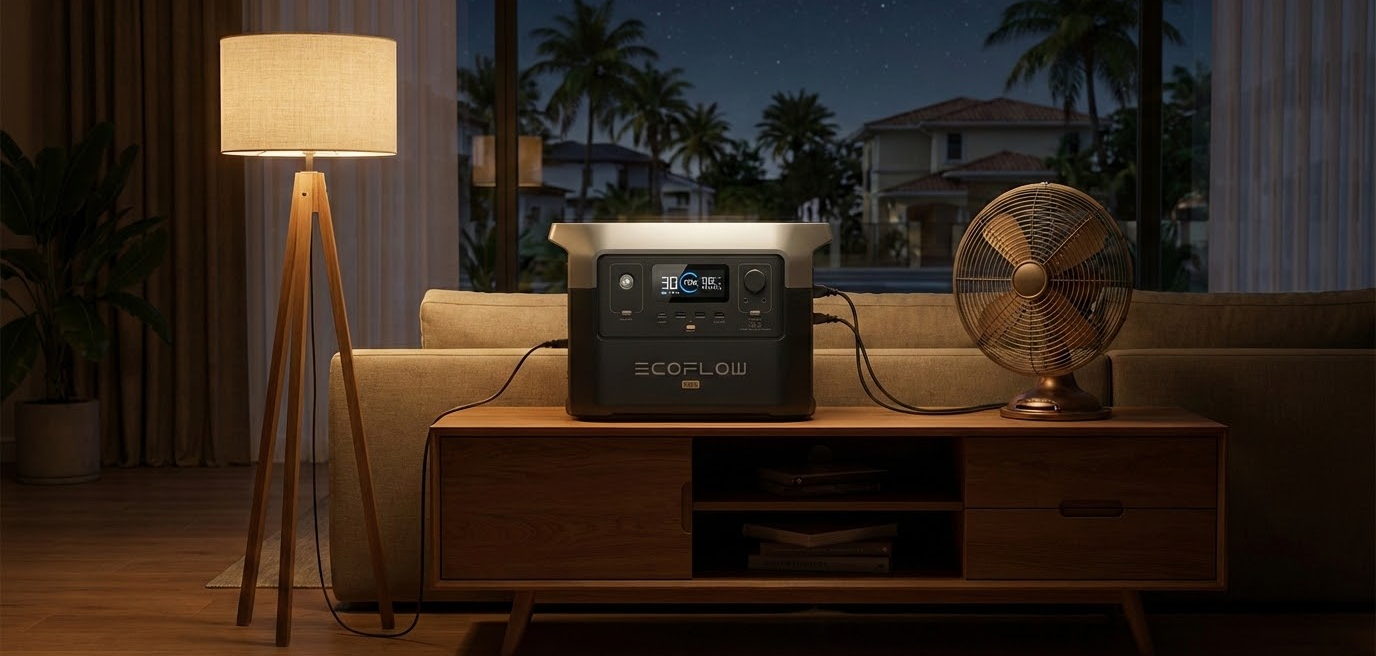
Battery power stations offer silent, emission-free backup power ideal for apartments and small homes. They can keep a fridge, CPAP, and phones running for 8-12 hours and recharge indefinitely using solar panels without relying on gas lines.
Will this thing actually last through the storm? It is the first question every Puerto Rico homeowner asks when looking at a battery power station. The answer depends entirely on what you plug in — and the math is simpler than you think.
LUMA outages in Puerto Rico are not like blackouts on the US mainland. In New York or Miami, a major outage lasts hours. In Puerto Rico, after a direct hurricane hit, extended outages are measured in days, weeks, and — in worst cases — months. The power station that handles your camping trip is a fundamentally different product proposition when it needs to carry your family through a 72-hour blackout.
This guide gives you the actual math behind battery runtime, real Puerto Rico home load examples, and a clear breakdown of when a power station is enough versus when you need a gas generator as backup.
Preparing for an outage means securing a reliable portable power station. Unlike gas models, a solar power station can be used safely indoors. If you combine an ecoflow power station or bluetti power station with portable solar panels, you instantly create a highly capable solar electric generator. These solar battery backup systems require zero maintenance. Building an off grid solar system doesn’t have to be daunting—starting with a simple solar panel kit and a reliable solar generator ensures your lights stay on.
The Only Formula You Need
Every battery power station runtime calculation uses the same three-step formula. Once you understand it, you can evaluate any power station for any device without relying on marketing claims.
⚡ The Runtime Formula
The 0.85 efficiency factor accounts for inverter losses and battery discharge inefficiency common to all power stations.
Example: A 1,000 Wh power station running a 150W refrigerator: (1,000 ÷ 150) × 0.85 = 5.7 hours. With solar recharging, that clock resets every sunny day — effectively giving you indefinite coverage on critical loads.
Real Puerto Rico Home Loads
The most common mistake PR homeowners make is using US mainland appliance guides. Puerto Rico’s housing stock skews toward window AC units, large refrigerators, and ceiling fans. Here is what a 1,000Wh station delivers for key PR devices:
Most PR families can cover their true essentials — refrigerator, fans, phone charging, and internet — with a 1,000–2,000 Wh power station. Air conditioning is the wildcard: a single window AC unit consumes more power than all other essentials combined.
How Capacity Affects Your Coverage
Below is the realistic coverage data for different station sizes running the Puerto Rico “Survival Load” (Fridge, 2 Fans, Lights, Phone, Router) totalling roughly 300W continuous.
“A power station plus solar panels is not just a backup — it is an infinite runtime system. As long as the sun rises over Puerto Rico, your essentials stay on.”
LiFePO4 vs. Lithium-Ion: Why Chemistry Matters in PR
Puerto Rico’s regular 90°F+ heat accelerates battery degradation in standard lithium-ion (NMC) chemistry. LiFePO4 (LFP) stations are engineered for exactly this high-heat, high-cycle environment.
| Feature | LiFePO4 (LFP) | Lithium-Ion (NMC) |
|---|---|---|
| Cycle Life | 3,500–6,000+ cycles | 500–1,000 cycles |
| Thermal Stability | EXCELLENT | MODERATE |
| 10-Year retention | ~80% of original | ~50% of original |
| Best for PR? | RECOMMENDED | NOT FOR HURRICANE PREP |
When a Station Isn’t Enough
Battery stations are exceptional for certain loads, but they have real limits that Puerto Rico families should understand before relying on one exclusively.
Central Air Conditioning
Central AC systems draw 3,000–5,000W continuously. No portable power station handles this economically for long. This is a generator load.
Extended 72-hour Storm Clouds
Back-to-back overcast days after a hurricane limit solar recharging. You need a gas generator to serve as a fast backup recharge source.
Well Pumps / Sump Pumps
Water pumps require massive “surge” watts to start (2,000W+). Most mid-sized stations will trip their breakers immediately.
Never Be Left in the Dark Again
Secure the highest-rated LiFePO4 power stations in Puerto Rico. Skip the mainland shipping delays and get local support.