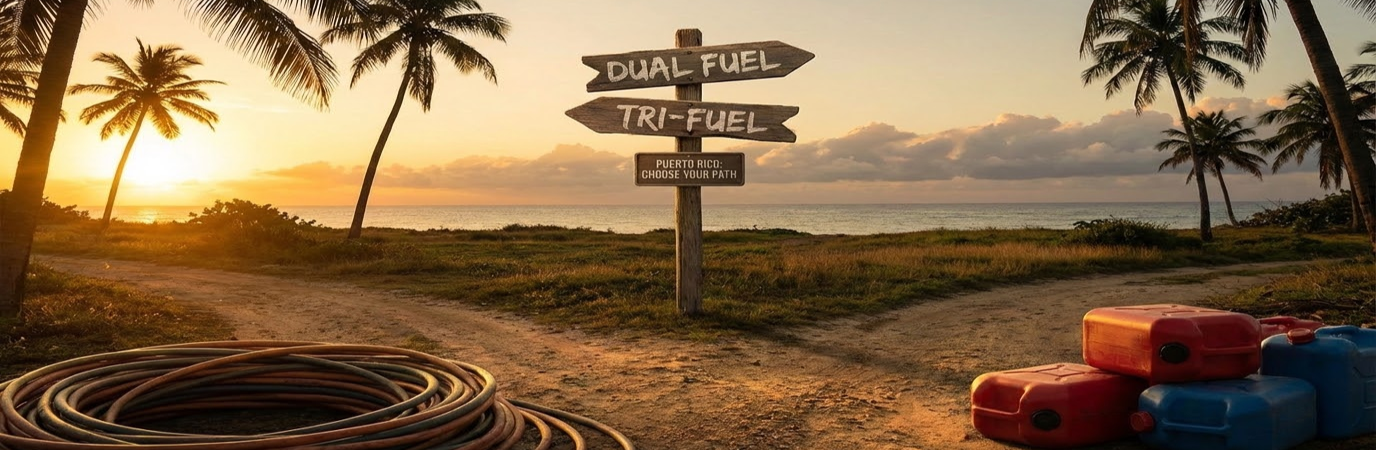
If your home in Puerto Rico does not have an active, piped natural gas line, a Tri-Fuel generator is a waste of money. Buy a Dual-Fuel generator and stockpile 100-lb propane tanks before hurricane season. Propane lasts 25+ years without degrading, unlike gasoline which spoils in 30-90 days in tropical heat.
When Hurricane Maria hit in 2017, gas lines stretched for miles—and many stations went dry within 24 hours. If your generator could only run on gasoline, you were powerless by day two. That is the exact problem dual-fuel and tri-fuel generators were built to solve.
Every hurricane season, the same scene plays out across Puerto Rico: LUMA cuts power, residents race to gas stations, and within hours, the pumps are either empty or only accessible to those willing to wait four hours in the heat. The generator that seemed like a perfect investment sits idle because it has only one fuel option.
Dual-fuel and tri-fuel generators give you flexibility when the grid and supply chains fail simultaneously. But they are not the same product, and choosing the wrong one for your situation can cost you real money. This guide breaks down every variable that matters for Puerto Rico homeowners specifically.
What “Dual Fuel” Actually Means
There is a major difference between a traditional open-frame unit and an inverter generator. Many homeowners searching for an inverter generator puerto rico are drawn to their quiet operation and clean energy waves. If you are comparing a standard portable generator against an i power inverter, fuel flexibility matters. Integrating a dual-fuel unit with your home’s transfer switch is the ultimate power move.
A dual-fuel generator runs on two fuel sources: gasoline and liquid propane (LP). Most models include a simple selector switch or dial that lets you swap between fuels without tools. The generator ships with connectors for a standard 20-lb or 100-lb propane tank, and the fuel lines handle the rest.
The core advantage is not performance — it is resilience. When gas is unavailable, you switch to the propane tank you stockpiled months in advance. When propane runs low, you refuel with gasoline from any station that has recovered. You are never fully dependent on one supply chain.
Gasoline requires a stabilizer additive to last more than 60–90 days in Puerto Rico’s heat and humidity. Propane stored in tanks has a shelf life of 25+ years with no degradation. Pre-hurricane propane stockpiling is the single most underrated prep strategy for PR homeowners.
PROPANE STORAGE — 100-lb tanks can be pre-filled months before hurricane season with no fuel degradation. Not possible with gasoline.
What “Tri-Fuel” Adds
A tri-fuel generator adds a third option: natural gas via a direct pipeline hookup. If your home has a natural gas line (less common in PR, but present in some developments), you can connect directly to the utility supply and run indefinitely — as long as the gas infrastructure is intact.
This sounds ideal, but the reality check for Puerto Rico is significant. Natural gas lines can be damaged in the same storm events that knock out electricity. More practically, natural gas penetration in Puerto Rico is very limited compared to the US mainland, meaning the majority of homeowners will never use this third fuel option.
If your home does not have an existing natural gas line, a tri-fuel generator’s third fuel option provides zero benefit. You will pay a $200–$400 premium for hardware you cannot use. Confirm your gas service before upgrading to tri-fuel.
The Wattage Trade-Off Nobody Talks About
Propane produces approximately 10% less power output than the same generator running on gasoline. This is due to propane’s lower BTU density per unit volume compared to gasoline. The generator’s engine produces slightly less mechanical power per combustion cycle.
In practical terms: if your generator is rated at 7,000 running watts on gasoline, expect approximately 6,300 watts on propane. For most home essential loads — refrigerator, fans, lights, phone charging, a small window AC — this reduction is irrelevant. If you are running a central air conditioning system or multiple large appliances simultaneously, size your generator with a 15% buffer when planning propane operation.
📊 Estimated Output Breakdown
Expect a ~10-15% drop when switching from gasoline to gaseous fuels.
Fuel Cost Comparison: The Full Picture
Gasoline feels like the familiar choice, but its economics look different when you account for Puerto Rico’s storage realities. Below is a cost comparison assuming a 7,000W generator running 8 hours per day during a 5-day post-hurricane outage.
| Fuel Type | Consumption Rate | Est. 5-Day Cost | Shelf Life in PR | Supply Risk |
|---|---|---|---|---|
| Gasoline | ~0.7 gal/hr | $140–$180 | 60–90 days | HIGH |
| Propane (LP) | ~1.0 lb/hr | $120–$160 | 25+ years | LOW |
| Natural Gas | ~100 cu ft/hr | $20–$45 | Continuous | MEDIUM |
“The cheapest generator is the one that actually runs when you need it. Fuel flexibility is not a luxury feature — in Puerto Rico, it is infrastructure.”
The Verdict: Who Wins?
Dual-Fuel Inverter
- You do not have natural gas service
- You want to pre-fill propane before hurricane season
- You want backup fuel resilience at lower cost
- Budget is a consideration
Tri-Fuel Generator
- Your home has an active natural gas line
- You want maximum runtime with no refueling
- You are in a development with buried gas (rare in PR)
- Budget is flexible
The Propane Pre-Season Strategy
Regardless of which generator type you choose, the single most effective preparedness action for Puerto Rico homeowners is propane pre-loading. In June, before any named storms threaten the island, fill your 100-lb tanks. Propane stored in sealed tanks will be just as potent in October as it was when you filled it — no stabilizer, no degradation, no concern.
Gasoline, by contrast, begins to degrade within 30 days in Puerto Rico’s heat without a fuel stabilizer like STA-BIL. Even with stabilizer, best practice is to use it within 6 months and rotate stock. This creates a logistical burden most homeowners do not maintain consistently.
Secure Your Fuel Freedom
Shop our curated selection of Dual and Tri-Fuel generators, tested for Puerto Rico's harsh tropical climate.